
Normativa y Cumplimiento DGOJ para Virtual Sports Betting
 Available in US
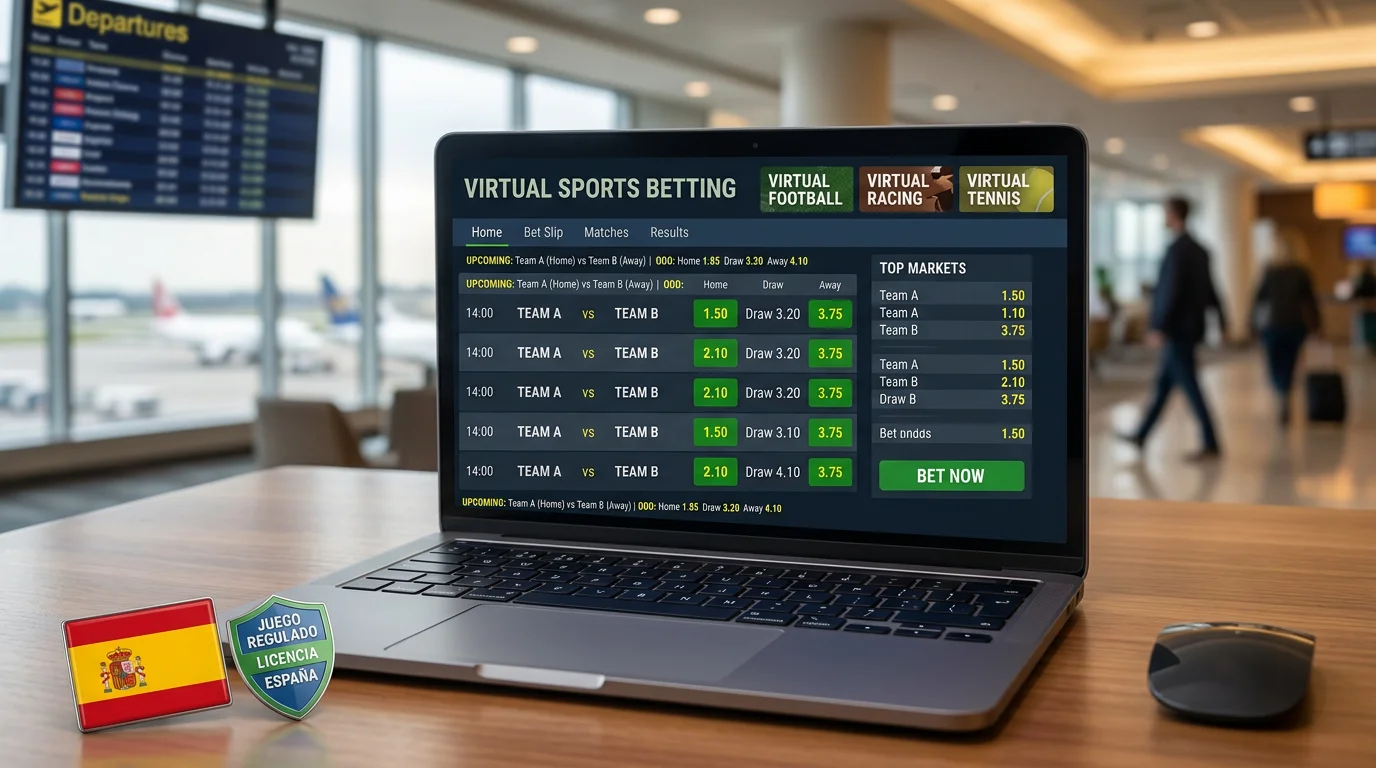
Spain is one of the three largest virtual sports markets in Europe, alongside the United Kingdom and Italy. For international bettors residing in Spain — or those considering using Spanish-licensed platforms — understanding how the local regulatory framework works is essential before placing the first wager. I have spent years analyzing this market and the Spanish licensing system is, in my view, one of the most transparent and well-enforced in Europe. What follows is a practical guide to virtual sports betting on Spanish-regulated sites, written specifically for those who may not be familiar with the DGOJ framework.
Requisitos de Licencia DGOJ para Operadores de Virtual Sports
The DGOJ — Dirección General de Ordenación del Juego — is the Spanish gambling regulator, operating under the Ministry of Consumer Affairs. It was established by the Gaming Act of 2011 (Ley 13/2011), which created the legal framework for online gambling in Spain. Any operator offering betting services — including virtual sports — to residents of Spain must hold an active DGOJ license.
The licensing process requires operators to meet strict technical, financial and responsible gambling requirements. For virtual sports specifically, operators must demonstrate that the RNG systems used by their providers have been certified by independent accredited laboratories — eCOGRA, GLI, iTech Labs or BMM Testlabs are the most recognized. Without this certification, a virtual sports product cannot legally operate on a DGOJ-licensed platform.
The DGOJ maintains a public register of licensed operators on its website. Any bettor — international or local — can verify whether a site holds a valid license before registering. This transparency is one of the key advantages of the Spanish market: you never have to rely on a site’s self-declaration about its legal status. As of 2024, the DGOJ had blocked 2,633 unlicensed sites over seven years, with 13 blocked in 2024 alone — demonstrating active enforcement against unlicensed operators.
For international bettors, the practical significance of the DGOJ license is threefold: your funds are protected by segregation requirements, the RNG producing virtual sports results is independently audited, and you have a formal complaints mechanism if something goes wrong with your account or a disputed wager.
Which Virtual Sports Providers Are Active on Spanish Sites
The Spanish market features all four of the global virtual sports leaders. Understanding which provider powers the virtual sports at a given operator helps you calibrate what to expect in terms of product quality, catalogue depth and market variety.
Inspired Entertainment — the only publicly listed virtual sports provider, trading on NASDAQ — has the deepest catalogue of themed content, including NBA and NFL-inspired games and virtual esports like CS:GO. Their products represent the premium end of the visual quality spectrum. Golden Race, headquartered in Budapest, has strong historical penetration in European continental markets and offers well-localised content with regional league themes. Kiron Interactive brings a technically robust product optimized for mobile performance, with a solid catalogue of standard disciplines. Betradar Virtual Sports, operated by data giant Sportradar, integrates real sports data into its probability models, lending an additional layer of statistical credibility to its products.
On Spanish-licensed sites, you are most likely to encounter Inspired, Golden Race or Kiron as the primary virtual sports provider. Betradar’s presence is also real but somewhat less widespread. The provider is usually identifiable by its logo in the virtual sports lobby — if it is not visible, a quick query to the operator’s customer support will confirm it.
What Makes the Spanish Virtual Sports Market Unique
Several features distinguish the Spanish virtual sports market from other European jurisdictions and are worth knowing for anyone entering it for the first time.
The first is the responsible gambling infrastructure. All DGOJ-licensed operators must implement deposit limits, loss limits, session time limits and self-exclusion tools. The national self-exclusion register — RGIAJ — allows a bettor to exclude themselves from all licensed operators simultaneously with a single request. This centralised system is more comprehensive than what exists in many other European markets, where self-exclusion is operator-by-operator.
The second distinctive feature is the advertising environment. The Real Decreto 958/2020 imposed strict advertising restrictions on the gambling sector: television advertising for online gambling is only permitted between 1:00 and 5:00 AM, social media advertising is effectively prohibited for mass audiences, and welcome bonuses cannot be actively promoted in mainstream media. For the bettor, this means you are less likely to encounter aggressive marketing for virtual sports than in some other European markets — but it also means bonus offers are harder to discover without actively seeking them.
The third feature is the scale of the market. With nearly two million active online gamblers in 2024 — a 21.7% growth year-on-year — and a GGR that exceeded 1.45 billion euros, Spain is a large and commercially significant market. This scale means that operators invest in high-quality products for Spanish users: well-localised interfaces, competitive odds and broad virtual sports catalogues are the norm among the licensed operators, not the exception.
For a full overview of the legal framework governing virtual sports betting in Spain, including operator obligations and player protection mechanisms, the detailed analysis at apuestas virtuales legales en España covers every dimension of the regulatory structure.
Practical Tips for International Bettors Getting Started
Having guided many international bettors through the process of getting started on Spanish-licensed platforms, I have found the same questions come up repeatedly. Here are the most practical points that save time and avoid common frustrations.
Identity verification is mandatory and non-negotiable. Every DGOJ-licensed operator is required by anti-money laundering regulations to verify the identity of account holders before processing withdrawals. This means submitting a valid government-issued ID — passport or national ID card — and in some cases a proof of address. The process typically takes between a few hours and 48 hours. Starting this process immediately after registration — rather than waiting until you want to withdraw — avoids delays when you actually need to access your funds.
Language should not be a barrier, but it sometimes is. Most major Spanish-licensed operators offer their platforms in English in addition to Spanish, and customer support in English is increasingly available. For virtual sports specifically, the interface is largely visual and numerical — odds, scores, countdown timers — which are universally readable. The terms and conditions of bonuses and the responsible gambling tools, however, are more often available only in Spanish. If your Spanish is limited, a basic understanding of key terms — wagering requirement, self-exclusion, deposit limit — will serve you well.
Currency is straightforward: all DGOJ-licensed sites operate in euros. International bettors using accounts denominated in other currencies should account for conversion fees from their bank or payment provider. Using a euro-denominated card or a multi-currency account eliminates these fees entirely and is the simplest solution for regular use.
Spain’s virtual sports market is growing at 17-18% annually and Europe remains the dominant global region for this category. With nearly two million active online gamblers in 2024 and a well-enforced regulatory framework, Spain offers international bettors both a high-quality product environment and genuine consumer protections that are not available in unregulated markets. For anyone choosing between a Spanish-licensed site and a grey-market alternative, the regulatory protections alone make the licensed option the clearly superior choice.
Can foreign bettors legally use Spanish-licensed virtual sports sites?
Yes. DGOJ-licensed sites are open to any adult resident in Spain, regardless of nationality, provided they meet the age verification and identity requirements (valid ID document — passport or national ID card). Non-residents physically located outside Spain cannot legally use DGOJ-licensed sites for real-money betting, as the Spanish license only covers activity within the Spanish territory. Residents in Spain — including foreign nationals — are fully entitled to use licensed Spanish sites.
Do Spanish virtual sports sites accept international payment methods?
Most DGOJ-licensed operators accept standard international payment methods: Visa and Mastercard credit and debit cards, PayPal, Skrill, Neteller and bank transfers. Some operators also accept Bizum, a Spanish instant payment system. Cryptocurrency payments are not accepted on DGOJ-licensed sites, as they are not an approved payment method under current Spanish gambling regulation. The available methods are listed in the cashier section of each operator’s platform.
Creado por la redacción de «Casas de Apuestas Deportvirtuales».